Leiboviz-Haviv Shirley, Gaon Ofir, Mimoun Nofar, Michal Ben-Shitrit Librush, Falah-Heib Eden, Zilberman Uri*
Pediatric Dental Clinic, Barzilai Medical University Center, Ashkelon, affiliated to Ben Gurion University of the Negev, Beer Sheva, Israel
*Corresponding author: Prof Uri Zilberman, Head of the Pediatric Dental Clinic, Barzilai Medical University Center, 2nd Hahistadrut St. Ashkelon, Israel.
Received Date: 05 October, 2026
Accepted Date: 13 October, 2026
Published Date: 16 October, 2026
Citation: Leiboviz-Haviv S, Gaon O, Mimoun N, Ben-Shitrit Leibush M, Falah-Heib E, et al. (2026) Caries Prevalence in Israeli School Children, Aged 6-16 Years in 2026. J Community Med Public Health 10: 587. DOI: https://doi.org/10.29011/2577-2228.100587
Abstract
Introduction: Children’s dental care policies have undergone dramatic changes in Israel during the last decades. Nationwide water fluoridation in Israel started in 2002 but terminated in 2014. In 2010, free dental care for children was included in the National Health Insurance Law, providing free dental care for children under 8 years, then expanding to all children up to the age of 18 years. Few epidemiologic studies on the dental health of children were performed before and after the administration of free dental care legislation. The current study examined caries status in a large cohort of children aged 6-16 years to assess the effect of the free dental care legislation on children’s dental health status. Methods: 7,011 healthy children from grades 1-9, age 6-16 years old, in the city of Ashkelon, Israel, were examined by residents in pediatric dentistry from the pediatric dental clinic at Barzilai Medical University Center, according to the World Health Organization oral health survey methods. Caries status was indexed as the summed number of decayed, missing and filled teeth (DMFT/dmft). Data was analyzed using non-parametric tests. Results: 52.6% of the children were caries free and mean DMFT was 1.76 (SD=2.61) . Caries’ status did not differ between girls and boys. The most caries-affected age was 8-9 years, (mean DMF = 2.94) with only 36.6% caries-free children. Children of higher socio-economic status had the lowest DMF results. In the primary dentition the second molar had the highest score and in the permanent dentition the first molar showed the highest score. In the primary dentition the treated component (f) exceeded the carious component (d) in almost all age groups, while in the permanent dentition the carious group (D) exceeded the treated group (F) in 7 out of the 9 age groups. Discussion: The results show a mild improvement in the dental status of Israeli children after the implementation of free dental care.
Keywords: Dental Caries; Child; Preventive Dentistry; Health Policy; Caries prevalence
Introduction
Policies of dental care for children have undergone dramatic changes in Israel during the last decades. Nationwide water fluoridation in Israel started in 2002 and led to a significant reduction in caries among children (Levy et al. 2023). However, a legislative change terminated it in 2014 (Levy et al. 2023; Yavnai et al. 2020), despite the opposition by the Israeli Dental Association, the Israeli Arab Dental Association, and senior university public health experts attacked the decision (Siegel-Itzkovich 2014). Children exposed to water fluoridation in Israel till 2014 had significantly lower rates of caries-related treatment, regardless of access to free dental care (Levy et al. 2023).
In 2010, free dental care for children was included in the National Health Insurance Law, providing free dental care for children under 8 years of age (Natapov et al. 2016; Yavnai et al. 2020). Until then, only School Dental Services, financed by state and provided by local authorities, offered dental care to primary school children in Israel . Most of the dental treatment was paid out of pocket but the high cost did not translate into a better oral health for Israeli children (Natapov et al. 2016). Free dental treatment for children expanded gradually (Yavnai et al. 2020) and from 2018 all children and adolescents up to the age of 18 years are eligible for free dental treatment at the four health insurance companies of Israel.
In the past twelve years children in Israel are entitled to free dental care, but their drinking water is not fluoridated. The present largescale study was designed to assess the oral health needs of Israeli children by measuring their DMFT, a measure approved by the World Health Organization (WHO) Oral Health Survey Methods (World Health Organization 2013). This measure aims to predict oral health needs in a population based on the number of teeth with decay (D in permanent dentition and d in primary dentition), missing teeth due to extractions (M/m), and teeth with restorations (F/f). DMFT (Decayed, Missing, Filled Teeth) in permanent dentition, or dmft in primary dentition, are universally accepted and are the most widely used indexes to assess caries experience (Broadbent and Thomson 2005).
During the last decades Israeli children have shown high DMFT/ dmft scores (Natapov et al. 2016), as demonstrated by several epidemiological surveys conducted since 1990, when a national survey among primary school children aged 5 (N=767) and 12 years (N=762) was performed. The survey reported a dmft of 2.7 and that 41% of children were caries free (Zadik et al. 1992). Several surveys followed: In 2002, the DMFT of 12-year-old children was 1.66 and 46% were caries free (Zusman et al. 2005). In 2016, a survey on 1,210 6–7-year-old children found a dmf of 2.56 and that 38.3% were caries free. This was the first time more teeth were found that were treated with fillings (f) than left untreated (d) (Natapov et al. 2016). In another survey performed in 2016 on 702 18-year-old Israelis, the DMFT was 1.95 and 46.7% were caries free (Yavnai et al. 2020).
The small scale of dmf/DMF data on Israeli children and adolescents during the last decades, as well as the small number of participants per age group, impair policymakers’ ability to assess the scale of the population’s needs and may undermine the design of efficient large-scale caries-prevention programs.
The present epidemiologic study is the largest of its kind performed in Israel to date. Over 7,000 school children aged 6-16 years from the city of Ashkelon were examined and their dmf/DMF data inform on the dental status of Israeli children.
Materials & Methods
A total of 7,011 healthy children from 18 schools in the city of Ashkelon, grades 1-9 (ages 6-16 years), were included in the study. The DMF/dmf scoring was performed during the annual dental examination of school children aimed to assess their dental needs. The annual examination is approved by the municipal authorities. The parents of the children signed an approval statement to examine the dental status of the children at school. The children were examined by four second year residents specializing in pediatric dentistry, with vast experience in dental examinations, according to the WHO Oral Health Survey Method (World Health Organization 2013). Each child was examined sitting, facing a natural light source, using only a dental mirror. One resident examined the child and a second resident, or an experienced dental assistant filled the dmf/DMF chart. The residents participated in a calibration exercise conducted by an experienced pediatric dentist (HLS) until a Cohen’s Kappa (McHugh 2012) of 0.85 or higher was achieved. The socioeconomic status of the examined children was based on the location of the schools and was received from the Ashkelon municipality.
Statistical Analysis
The data was transferred to a computer, and group comparisons were tested using non-parametric tests. Differences in caries prevalence were tested using chi-square tests, differences in DMFT between each two groups were tested using the Mann-Whitney test, and differences among three or more groups were tested using the Kruskal-Wallis’s test. Results
Sample Description
A total of 7,011 students who underwent dental examinations in 18 schools in the city of Ashkelon, in grades 1 to 9 (aged 6-16 years), were included in the study. The sample comprised 3,683 boys (52.5%) and 3,328 girls (47.5%). 3,268 students (46.6%) were in primary school (grades 1 to 6) and 3,743 students (53.4%) were in middle school (grades 7 to 9). The distribution of students by grade is presented in Table 1.
|
Grade |
Frequency |
Percent |
|
1 |
855 |
12.2 |
|
2 |
529 |
7.5 |
|
3 |
544 |
7.8 |
|
4 |
522 |
7.4 |
|
5 |
407 |
5.8 |
|
6 |
411 |
5.9 |
|
7 |
1,458 |
20.8 |
|
8 |
1,169 |
16.7 |
|
9 |
1,116 |
15.9 |
|
Total |
7,011 |
100 |
Table 1: Distribution of students by grade.
Caries Prevalence and Mean DMFT
Caries prevalence in the total sample was 47.4%, with 52.6% of students being caries-free. The mean DMFT was 1.76 (SD=2.61), and the range was 0 to 24.The distribution of DMFT scores in the sample was asymmetric and right-skewed, with a marked concentration of zero scores (that belong to the caries-free participants). The median is therefore reported alongside the mean.
Caries prevalence and mean DMFT by grade and age groups are presented in Table 2. An increase in the lower grades followed by a decline in higher grades was observed, with the peak of caries in grades 2 and 3 (prevalence of 58.8% and 63.4%, respectively) and a gradual decline to about 40% in the middle-school grades.
These differences among grades were significant, both in caries prevalence (χ²(8) = 182.63, p < .001), and in mean DMFT, (H(8) = 302.65, p < .001). Subsequent pairwise comparisons with Bonferroni correction (Dunn’s test for DMFT scores and comparison of proportions for prevalence) indicated the same pattern for both measures. Grades 2, 3, and 4, in which the peak of caries was found, had a higher DMFT than most other grades (p ≤ .002 for all significant comparisons) and did not differ from one another. The middle-school grades (7, 8, and 9) showed the lowest levels of DMFT and did not differ from one another. Grade 1 differed from the middle-school grades (p≤.001), whereas grade 6 did not differ from them.
|
Grade |
Age |
N |
DMFT/dmft prevalence (%) |
Mean (SD) |
Median |
|
1 |
6-7 |
855 |
48.9 |
2.07 (2.97) |
0 |
|
2 |
7-8 |
529 |
58.8 |
2.82 (3.27) |
2 |
|
3 |
8-9 |
544 |
63.4 |
2.94 (3.24) |
2 |
|
4 |
9-10 |
522 |
59.6 |
2.66 (3.11) |
1 |
|
5 |
10-11 |
407 |
51.8 |
1.74 (2.45) |
1 |
|
6 |
11-12 |
411 |
45.3 |
1.46 (2.21) |
0 |
|
7 |
12-13 |
1,458 |
39.8 |
1.21 (1.98) |
0 |
|
8 |
13-14 |
1,169 |
43.7 |
1.33 (2.14) |
0 |
|
9 |
14-15 |
1,116 |
40.2 |
1.34 (2.27) |
0 |
|
Total |
7,011 |
47.4 |
1.76 (2.61) |
0 |
|
|
Note: Caries prevalence = percentage of students with a DMFT score greater than zero. |
|||||
Table 2: Caries prevalence and mean DMFT by grade (per age group).
DMFT by sex
Examining the difference between the sexes per grade (Table 3) revealed a higher DMFT score among boys in grade 4 (ages 9-10) (z = -2.88, p = .004), and among girls in grade 8 (ages 13-14) (z = -2.02, p = .044). No other inter- sex differences were found in the remaining grades and in the total sample.
|
Sex |
N |
Caries prevalence (%) |
Mean (SD) |
Median |
|
Boys |
3,683 |
47.1 |
1.77 (2.63) |
0 |
|
Girls |
3,328 |
47.7 |
1.76 (2.60) |
0 |
|
Total |
7,011 |
47.4 |
1.76 (2.61) |
0 |
Table 3: Mean DMFT by sex.
Caries prevalence and socio-economic status
The socioeconomic status in Ashkelon was between 5-7. In the overall analysis, the socioeconomic levels differed in caries prevalence (χ²(3) = 22.03, p < .001), and in DMFT score (H(3) = 46.55, p < .001), with higher DMFT scores found in the lower socioeconomic groups. Caries prevalence and mean DMFT by socioeconomic status are presented in Table 4. Pairwise comparisons with Bonferroni correction showed that the integration group had lower DMFT scores than group 5 (p < .001) and group 5-6 (p = .008). Group 5 had higher caries prevalence (at a corrected level of p < .05) than group 6-7 and the integration group.
|
Socioeconomic status |
N |
Caries prevalence (%) |
Mean (SD) |
Median |
|
5 |
1,419 |
52.3 |
2.21 (3.01) |
1 |
|
5-6 |
303 |
52.1 |
2.19 (2.96) |
1 |
|
6-7 |
984 |
46.4 |
2.00 (2.92) |
0 |
|
Integration |
4,305 |
45.6 |
1.53 (2.33) |
0 |
|
Total |
7,011 |
47.4 |
1.76 (2.61) |
0 |
Table 4: Caries prevalence and mean DMFT by socioeconomic status.
Caries components (dmf/DMF) by tooth groups
The caries components for each tooth group, primary (dmf) and permanent teeth (DMF) are presented in Table 5 (primary dentition) and Table 6 (permanent dentition).
|
Tooth group |
d |
m |
f |
dmf |
% affected |
|
Central incisors (A) |
0.01 |
0 |
0 |
0.01 |
0.7 |
|
Lateral incisors (B) |
0.01 |
0 |
0 |
0.01 |
0.6 |
|
Canines (C) |
0.02 |
0 |
0 |
0.02 |
1.5 |
|
First molars (D) |
0.16 |
0.03 |
0.21 |
0.4 |
17.1 |
|
Second molars (E) |
0.2 |
0.03 |
0.27 |
0.5 |
21.6 |
|
Total (primary) |
0.4 |
0.06 |
0.49 |
0.95 |
25.4 |
|
Note: d, m, and f are the mean number of decayed, missing, and filled teeth per child, and sum to the mean dmf within each row. The tooth-group rows sum to the total for the dentition. “% affected” is the percentage of children with dmf > 0 in the tooth group; these values do not sum the column, as a child may have caries in more than one tooth group. In the total row, “% affected” is the percentage of children with any caries in primary dentition. |
|||||
Table 5: Caries Components by Primary Tooth Group.
|
Tooth group |
D |
M |
F |
DMF |
% affected |
|
Incisors |
0.02 |
0 |
0 |
0.03 |
1.4 |
|
Canines |
0 |
0 |
0 |
0 |
0.3 |
|
Premolars |
0.04 |
0 |
0.03 |
0.07 |
4 |
|
First molars (6s) |
0.28 |
0.01 |
0.3 |
0.59 |
26.7 |
|
Second molars (7s) |
0.08 |
0 |
0.03 |
0.12 |
6.6 |
|
Total (permanent) |
0.44 |
0.01 |
0.37 |
0.82 |
28.6 |
Note: D, M, and F are the mean number of decayed, missing, and filled teeth per child, and sum to the mean DMF within each row. The tooth-group rows sum to the total for the dentition. “% affected” is the percentage of children with DMF > 0 in the tooth group; these values do not sum the column, as a child may have caries in more than one tooth group. In the total row, “% affected” is the percentage of children with any caries in the permanent dentition.
Table 6: Caries Components by Permanent Tooth Group.
Caries components by age group
D, M, and F components were examined per age group within each dentition. In the permanent dentition, the mean D component rose from 0.09 at ages 6-7 to 0.67 at ages 14-15, and the mean F component rose from 0.03 to 0.63 over the same range; the M component was 0.02 or lower in every age group. In the primary dentition, the mean d component was highest at ages 8-9 (1.05) and declined to 0.01 at ages 14-15, the mean f component was highest at ages 7-8 (1.34) and declined to 0.01, and the m component was 0.23 or lower in every age group. The components by age group are shown in Figure 1 (permanent dentition) and Figure 2 (primary dentition).
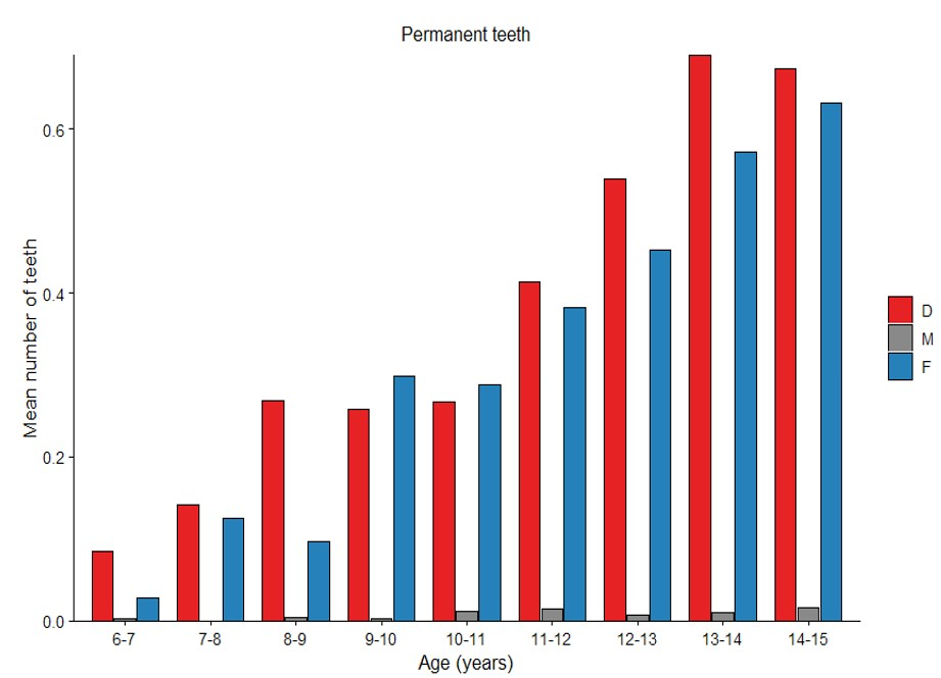
Figure 1: Mean Number of Decayed, Missing, and Filled permanent teeth by age group (N = 7,011). Note: Bars show the mean number of decayed (D), missing (M), and filled (F) permanent teeth per child in each age group.
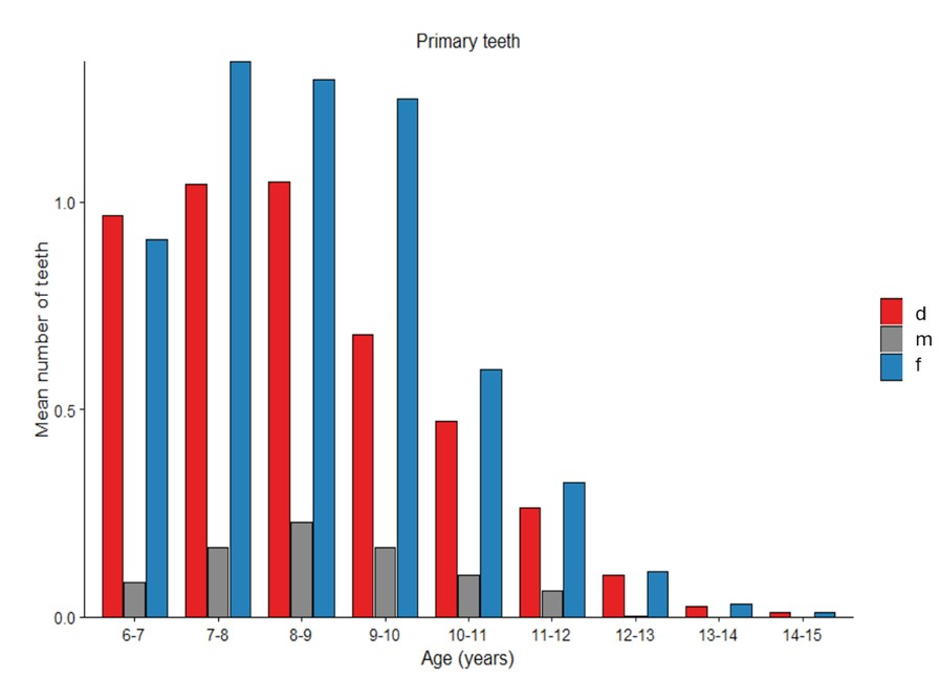
Figure 2: Mean Number of decayed, missing, and filled primary teeth by age group (N = 7,011). Note: Bars show the mean number of decayed (d), missing (m), and filled (f) primary teeth per child in each age group.
Dental needs by age group and dentition
Mean DMFT/dmft scores were computed separately for the permanent and primary dentitions within each age group (Figure 3). In the permanent dentition, caries prevalence rose with age, from 5.7% at ages 6-7 to 39.5% at ages 14-15, and mean DMF rose from 0.12 to 1.32 over the same range. In the primary dentition, caries prevalence was highest at ages 7-9 (56.3% for 7-8 and 60.5% for 8-9) and declined to 1.5% at ages 14-15. Mean DMF peaked to 2.5-2.6 at ages 7-9 and declined to 0.02 over the same range.
The treated component was higher than the untreated component in all age groups except the youngest (6-7 years), where the treated component was similar to the untreated component. In the permanent dentition, the decayed component was higher than the treated component, except in ages of 9-11 years, where the treated component was higher than the decayed component.
Overall caries prevalence (any tooth, either dentition) by age group is shown in Figure 3.
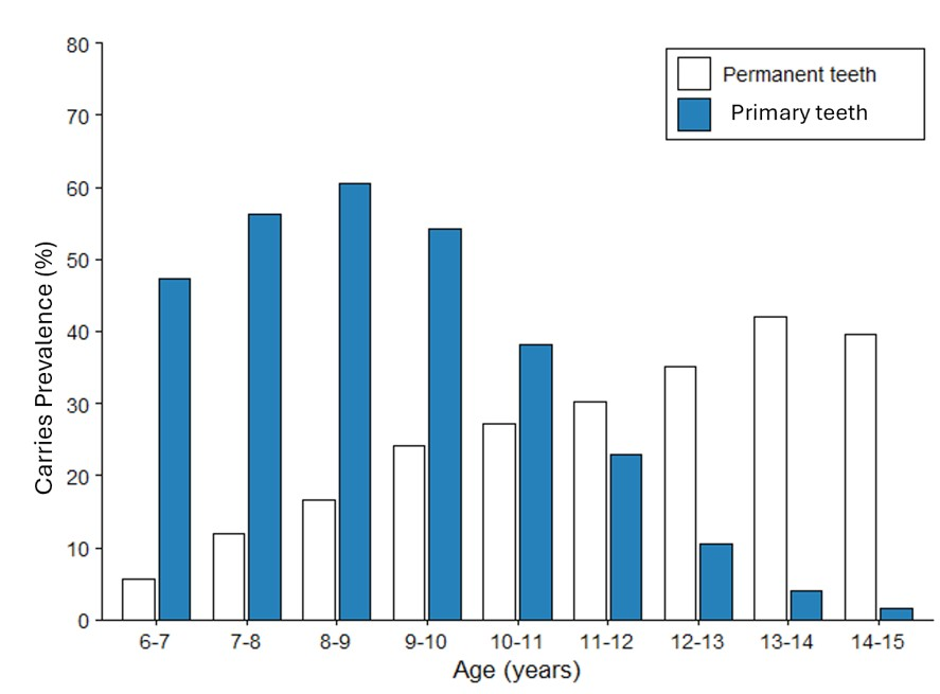
Figure 3: Caries prevalence by age group and dentition (N = 7,011). Note: Bars show the percentage of children with any caries experience (DMF > 0) in the permanent and primary dentitions, presented separately for each dentition. The two dentitions are shown separately because a child in the mixed-dentition years may have caries in both, and the two percentages therefore cannot be combined into a single value.
We compared the caries prevalence of 6-7 years old children in the current study to that found in a study on 6-year-old children in 2016, who had access to fluoridated water all their life (Natapov et al. 2016). All children had the same socio-economic status level 5-7. As shown in Table 7, the two cohorts did not differ in their caries prevalence.
|
Study |
Year |
N |
Caries free |
d |
m |
f |
dmft (SD) |
|
Natapov et al. |
2016 |
307 |
48.20% |
0.8 |
0 |
0.94 |
1.74 (2.37) |
|
Current study |
2026 |
855 |
51.10% |
1.052 |
0.085 |
0.936 |
2.07 (2.97) |
Table 7: Carries prevalence in 2016 versus 2026.
Carries prevalence in 1st class students (6-7 years) of socio-economic status level 5-7 who had access to fluoridated water (2016) vs. the prevalence in children from the same age and socio-economic status ten years later (2026), when Israeli children have no access to fluoridated water.
Discussion
This is the largest epidemiologic research on caries prevalence in children and adolescents ever carried out in Israel. The results show that 16 years after the inclusion of dental health in the National Health Insurance, the number of caries free children increased by 54% and the dmf of young children has decreased by almost 40%. In the 12 years old, the number of caries free children increased by 30% and the DMF was reduced by 37%.
Dental needs in primary dentition increased from the age of 6-7 years to 8-9 years, and in permanent dentition they peaked in the 13-14 years’ group. The results regarding dental needs provision are encouraging in the primary dentition, as the treated component was higher than the untreated component in all age groups except the youngest (6-7 years), in which the treated component was similar to the untreated component. In the permanent dentition the results are less positive, as the decayed component was higher than the treated component in all age groups except in the 9-11 years, where the treated component was higher than the decayed component. In primary dentition the prevalence of dental caries varied between 10% at age 12-13 to 60% at the age of 8-9 years, with a mean of 41.1%. Compared with worldwide prevalence of dental caries in primary dentition (Kazeminia et al. 2020), Israelis’ carries prevalence resembles that in America (45.8%), is higher than Europe (21.4) and Australia (28.5%), but lower than Asia (52.6%) and Africa (53.1%). In the permanent dentition the dental caries prevalence varied between 5% at age 6-7 to 42% at the age 13-14 years old, with a mean of 27%. In comparison to worldwide prevalence in permanent dentition, Israeli children showed lower dental caries prevalence than that found in all continents (Kazeminia et al. 2020). A comparison of the prevalence of dental caries in 6-7 years old Israeli children (48.9%) with worldwide prevalence of dental caries in 5 years old children (Chen et al. 2019) shows that the prevalence in Israel is lower than in Africa (56.1%), the Middle East (66.9-75%), South America (Brazil mean 56.1%) and most of Asia (55-90%), but higher than some regions in India (Bangaluru with 27.5% and Adhra Pradesh with 22.9%) and Europe (25.2-43.4%), except North Western Greece (64.2%) (Kazeminia et al. 2020).
An inverse correlation between socioeconomic strata and the prevalence of caries was found: the higher the socio-economic level, the less dental disease recorded, this is in accordance with the results of a previous study on Israeli children (Natapov et al. 2016). The level of dmf in the current study was similar to the data from 2016 when the water was fluoridated in Israel. It shows that the impact of water fluoridation on dental decay is not so important as was believed, and the impact of fluoridated toothpastes is more important as described also in a Cochran summary on water fluoridation (Iheozor-Ejofor et al. 2024).
The combination of high caries prevalence with a high treatment component found in the current study may stem from the main limitation of the law of free dental care for children and adolescents, i.e., its lack of a prevention component, such as mandatory dental examinations every six months. This creates a situation in which children come to the clinics mainly for dental care and not for caries prevention. In 2024, the first WHO global Oral Health Meeting that took place in Bangkok, Thailand, produced the Bangkok declaration- No health Without Oral Health that advocates elevating the priority of oral diseases in global public health programs and emphasizes the need to strengthen health systems through primary health care approaches, mainly prevention (World Health Organization 2025).
Study limitations: The research was performed in a single city, Ashkelon, in the south of Israel, which has a socio-economic rating of 5-7. To get a nation-wide representation of the caries status of Israeli children and adolescents, larger study-sampling children from other areas in Israel should be performed on a more comprehensive population range.
Also, Molar Incisors Hypomineralization (MIH) and Second Primary Molar Hypomineralization (SPMH) may affect the results of DMF/dmf. In the current study, the most affected tooth (DMF/ dmf) in the permanent dentition was the first molar and in the primary dentition the second molar, which are the teeth affected by MIH and SPMH. The prevalence of MIH in Ashkelon in 2016 was 15.6% in 11–16-year-old children and 19.7% in 6-10 years old (Hassan J, Leibovitz-Haviv S, Cohen O, Zilberman U 2019), and in 2024 it increased to 32% (unpublished data). Further studies on the DMF/dmf of MIH and SPMH teeth are needed to clarify the influence level of these phenomena on caries prevalence in children and adolescents in Israel and worldwide.
Conclusions
The current large-scale study found that the inclusion of dental care in the National Health insurance in Israel increased the number of caries free children and adolescents and reduced the dmf/DMF.
However, the caries prevalence found is far from satisfactory.
Ethics Statement
This study was approved by the city council of Ashkelon as part of annual dental examinations performed on all 1-9 grade students in the city.
Authorship
Haviv-Leibovich Shirley: Methodology, Investigation, Validation, Gaon Ofir, Maimon Nofar, Ben-Shitrit Leibush Michal, Falah Hib Eden: Investigation, Zilberman Uri: Conceptualization, Methodology, Supervision, Writing original draft.
Acknowledgements
Mrs. Anat Steiner-Director manager of dental services and Mrs.
Yamit Abohzira- Secretary of dental services in Ashkelon.
References
- Broadbent JM, Thomson WM (2005) For debate: problems with the DMF index pertinent to dental caries data analysis. Community Dent Oral Epidemiol 33: 400-409.
- Chen KJ, Gao SS, Duangthip D, Lo ECM, Chu CH (2019) Prevalence of early childhood caries among 5-year-old children: A systematic review. J Investig Clin Dent 10: e12376.
- Hassan J, Leibpvitz-Haviv S, Cohen O, Zilberman U (2019) The prevalence of Molar Incisor Hypomineralization among children in Jewish and Arab population in Israel. J Israeli Dent Assoc 36: 28-36.
- Iheozor-Ejiofor Z, Walsh T, Lewis SR, Riley P, Boyers D, et al. (2024) Water fluoridation for the prevalence of dental caries. Cochrane Database Syst Rev 10: CD010856.
- Kazeminia M, Abdi A, Shohaimi S, Jalali R, Vaisi-Raygani A, et al. (2020) Dental caries in primary and permanent teeth in children’s worldwide, 1995 to 2019: a systematic review and meta-analysis. Head Face Med 16: 22.
- Levy DH, Sgan-Cohen H, Solomonov M, Shemesh A, Ziv E, et al. (2023) Association of Nationwide Water Fluoridation, changes in dental care legislation, and caries-related treatment needs: A 9-year record-based cross-sectional study. J Dent 134: 104550.
- McHugh ML (2012) Interrater reliability: the kappa statistic. Biochem Med 22: 276-282.
- Natapov L, Sasson A, Zusman SP (2016) Does dental health of 6-year-olds reflect the reform of the Israeli dental care system? Isr J Health Policy Res 5: 26.
- Siegel-Itzkovich J (2014) Israel’s Health Minister Stuns Experts by Ending Mandatory Fluoridation. BMJ 349: g5240.
- World Health Organization (2013) Oral Health Surveys: Basic Methods. 5th edition.
- World Health Organization (2025) No Health without Oral Health: Towards Universal Health Coverage for Oral Health by 2030. Paper presented at Bangkok Declaration.
- Yavnai N, Mazor S, Vered Y, Shavit I, Zini A (2020) Caries prevalence among 18 years old, an epidemiological survey in Israel. Isr J Health Policy Res 9: 45.
- Zadik D, Zusman SP, Kelman AM (1992) Caries prevalence in 5- and 12-year-old children in Israel. Community Dent Oral Epidemiol 20: 5455.
- Zusman SP, Ramon T, Natapov L, Kooby E (2005) Dental health of 12-year-olds in Israel-2002. Community Dent Health 22: 175-179.